Thursday, September 02, 2010
Opportunities for community, discovery and transformation through golf.
Articles
MENU ITEM VIEW ITEM

[This interview first appeared in Issue 4 of The Journal of the Shivas Irons Society]

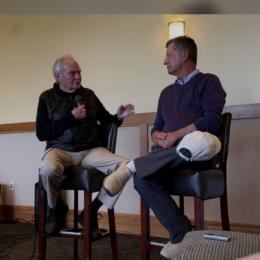
Fred Shoemaker is a golf teacher of a rather different stripe. He isn’t so much into instructing on the mechanics of the swing, although that is certainly included in his schools, but in his students learning how to connect with their golfing soul, so to speak. Shoemaker’s method has a Socratic turn to it. He believes there must be a dialogue between the student and the coach, a term he prefers over teacher. He doesn’t want his students to simply listen and do as told, but to ask questions, question the answers, and in the final analysis become self-taught golfers who learn through their own experience, their own sense of self, and become their own best teacher. The concept has a celestial thrust, but on a practical level is a worthy goal if only because golfers must recognize when their swing or concentration is not going well and then have the wherewithal to correct the problems in the midst of a round.

In this interview we discover how Fred came to this method of instruction, but perhaps more importantly, why he embraces it.

Journal: How did you get involved in golf?


Shoemaker: I’m from a military family, and my Dad moved around a lot. Much of my youth was spent in Guam, Taiwan, and the Philippines. I played my first golf in Guam. The Naval base had an 18 hole course, and a short nine. I started when I was six, going around that short nine over and over again. Why golf? My father played, but he didn’t push it on me. Sometimes you get into something that you know is the right thing for you. I fell in love with the game. It was the whole ambiance. I found it all fascinating. And still do.


Journal: Were you a good player from the start?


Shoemaker: Pretty much. I played in something like 250 amateur tournaments before I was 21 years old. Mostly in California, where my father retired, but I also played in national events—the United States Amateur, the Trans-Miss, and the Canadian Amateur.


Journal: How did you do?


Shoemaker: I won some matches and some smaller tournaments, but eventually competitive golf got to be only about who is the best, and if you played well you were somehow a better person than when you played poorly. It got to be about rating your character based on your golf score. I couldn’t get a good conversation going with other golfers about doubt, fear, lack of trust, how you really learn, how to overcome obstacles, things like that. What would be uncommon would be a conversation with someone who was looking for something other than a golf swing how-to.


Journal: Did you ever get involved in technique? Or were you just a naturally good player?


Shoemaker: I think everybody is natural. You lose that naturalness in the first year of your play, because you think someone else has an answer for you. Generally, we look outside ourselves for answers. It’s not any different from the rest of our lives. I’ve given 50,000 individual lessons, more or less, since 1973 and I’ve never had one person come back to me and say, “I have everything I need. I have a great golf swing inside me. Lead out what’s already there!” Instead, I hear people saying that there’s something wrong with their swing and they’re asking to have it changed, to get it fixed.


Journal: When they ask that are they bedeviled by a lack of athletic talent, or an ability to concentrate?

Shoemaker: I think that people simply lack awareness and a safe environment in which to learn. It’s like the analogy of the acorn and the oak tree. All it takes is a little water, some sunshine and the right environment to make the acorn grow into an oak tree. Teaching golf is the same thing. The students, like acorns, have everything they need, and in the right environment they flourish.


Journal: When did you begin to evolve this method of instruction or coaching, and why?


Shoemaker: When I was 22 years old I took a golf lesson during which a particular thing happened to me. For years the two middle fingers of my right hand would come off the club at the top of my backswing. In resetting the fingers the angle of the clubface would often shift. It’s hard to control the flight of the ball when you do that, so I took a lesson from Tim Gallwey, who was famous for his book, The Inner Game of Tennis. He didn’t teach golf at the time [Gallwey would eventually produce The Inner Game of Golf], but I had been to enough golf pros and I wanted to go to someone who was different. The first thing he said to me was, “What do you really want?” I told him that once and for all I wanted to stop letting go of the club. Then he asked me how I knew I was doing it. That’s when I came to realize that anything ineffective that persists in a golf swing, such as your fingers coming off the handle, is something you don’t experience. We see it on video, friends tell us about it, we see the results in our shots, but we don’t experience the moment when it happens. It was embarrassing for me, after 22 years of golf and hitting thousands and thousands of balls, that I had never experienced my fingers on the club.


Journal: In all that time you never once thought about why you were letting go of the club?


Shoemaker: You have to be careful how you take that, and the language you use. Asking why doesn’t get you the experience. You want to get people crazy, ask them why. Want to get them sane, ask them what. What happened versus why it happened. Gallwey was saying to simply let it do it, don’t try to stop it. He made it so it wasn’t a bad thing. Now I could be curious about it, and after ten minutes of hitting balls I actually, for the first time, felt my fingers move. I laughed. Then I decided to consciously hold the fingers on, but Gallwey said no, just let it go. The fingers started to move and I felt the face change at the top of the swing. It was incredible. I could really see the correlation between the change in the clubface and the flight of the shots. But after awhile, 25 minutes or so, I noticed my fingers began to get calmer on the club. And after 45 minutes my fingers stopped moving, and they have never moved since. After 22 years of doing something, in 45 minutes it no longer happened because of my own awareness of it. It was like a thunderbolt hit me.
I grew up in everything traditional about golf. I knew all the theories and here is this guy, Gallwey, who doesn’t know anything about golf technique, doesn’t know if the fingers coming off is a bad or good thing, telling me to simply trust my own awareness in a non-evaluative environment. And from experiencing the problem it disappeared.


Journal: Is this episode to say that golf is played more by feel than a conscious system?


Shoemaker: You call it feel; I call it being present, which is the entire sensory experience. Feel is a part of it. You can have a sense of all sorts of things. But I would simply say the best golf is played in the present.
Journal: How does what or how you teach differ from that of a sports psychologist, a Bob Rotella or Dick Coop?
Shoemaker: I have no interest in psychology. Psychology is the study of the mind. My interest is in the study of being with a capital B. Being. There are three basic modes of teaching golf that have developed over the past 200 years or so. One is, ‘Do Something.’
    You get on the range and what you see is someone standing behind someone else telling that person what to do. That’s maybe 99 percent of teaching, and is accepted by everyone as the way the game is supposed to be taught. I think it’s a very limited form of instruction, and as we know the average handicap among average golfers hasn’t changed much since they began keeping it.
    A second way that has been heavily pioneered in the last 30 years could be called Awareness Instruction. ‘Pay attention and experience what you’re doing.’ It’s very powerful. As your awareness of the physical reality of your swing increases, your golf scores do down. It’s a perfect inverse ratio.
    A third kind of instruction could be called Being Instruction or an awareness of who you’re being during the activity. Are you being free? Are you being present? Are you being a person who trusts himself? To be aware of who you’re being and shifting it could be the powerful golf instruction of all.
    By the way, if you asked golfers if they trust themselves most would say they don’t and it shows in their constant attempt to fix their swings. You don’t have to fix something you trust.


Journal: Isn’t it because they have hit a lot of poor shots?


Shoemaker: No, I think it’s because they’re not confident out of a lack of awareness. When a person shanks a ball, he doesn’t know what happened. The ball went sideways but he didn’t experience what happened. Or how it happened. So the fear is that it will happen again. That’s what makes him afraid. It’s like this. Suppose you are walking to your car and you end up on the pavement, fell and hurt yourself. You don’t know how you got there, why you fell, which makes you afraid. But if you can actually experience the falling down, or in our context the shank, then you will know what to do and there’s no fear.


Journal: What if a person doesn’t have good hand-eye coordination or other natural athletic gifts. Can a klutz who wants to play well, play well?


Shoemaker: I’ve never met a ‘klutz.’ I’ve met people who interfere with their ability more than others. People who, from the time they were young, built up a self-image that they were no good at ball sports and then fulfilled that self-image when they started to play golf. They don’t see a golf ball or a golf course. They see threats and respond with fear and over-tightening. Part of coaching golf is to assist people to let go of limiting self-images and to experience the genius of their body. People are absolutely amazing but rarely do they see it.
    Every person brings some gifts to the game. Most teachers of golf look at students for their hand-eye coordination or a physical prowess. But they may have the gift of concentration, which to me is far more important than any physical asset. Concentration allows them to learn, and learning how to learn may be more important than what you learn. They may have a gift for commitment, so they aren’t shaken by first failure. I would like a person to have that more then what they consider natural power.

Journal: When did you become a professional?

Shoemaker: I turned professional when I was 26, right after I saw Tim Gallwey. There is definitely a relationship between the two events. I realized what I wanted to do, to assist people through golf discover their own extraordinary nature. Golf can be a vehicle for so much more than getting a single-digit handicap.

Journal: But before that there was a sojourn in Africa.

Shoemaker: Yes. This was after my meeting with Gallwey. I was now a golf professional, but I didn’t see anything in the game that would open up the future in the game for me. It was the same old stuff, and conversations about the golf swing put me to sleep. So I took some time off and joined the Peace Corps and worked for a time in Ghana. After the first year I was asked to run a training program for incoming volunteers and Ghanian staff. At first I said I couldn’t do that. Heck, I couldn’t manage my own life. But the director of the project saw something in me that I didn’t see in myself. It was the most inspiring time of my life. I worked 12 hours a day, and when it was over I was fully clear in my mind that coaching and teaching golf could be an experience that could make a difference in people. Before, I couldn’t see myself dedicating my life standing on a tee talking about backswings and downswings. I thought that was a moronic way to spend a life. But after Ghana I realized that it isn’t what you do but who you bring to whatever it is you do. My life changed just like that. One of the things about coaching golf is you see things in or about people that they don’t see in themselves.


Journal: Do you still play well?

Shoemaker: I do, real well, and I keep score. It’s still golf, putting the ball in the hole in as few strokes as possible. If our golf schools didn’t develop people in their golf technique and scoring ability we wouldn’t have a 94 percent attendance rate for 16 straight years, and by word of mouth. It’s a question of finding out what people want, and fulfilling it that makes our golf program work. People don’t want just information. They want peace of mind, self-coaching and to learn how to get out of their own way. That’s what they tell me.
    Most people play golf with a lot of doubt. It’s the number one source of technical error, of poor swings. Doubt comes before fear. If you didn’t doubt you wouldn’t fear. Doubt by the very nature of the word has a physical component, which is over-tightening of the muscles. Now the club can no longer drop into the slot from the top of the backswing, for one thing. The club comes over the top and the person thinks the problem is technique. That’s insanity. How about dealing with the doubt that created the poor technique, rather than the technique itself? Very few people ever admit interfering in this way, and it is prevalent everywhere in golf. But no one ever says, ‘I just interfered.’ If they told the truth about it than they could begin to work with doubt itself. Doubt is an internal conversation accompanied by bodily sensations.
    When a person becomes effective in letting go of doubt, then feel arises. They can now feel their body more. They can sense their relationship to the target. Or, they can choose to feel the clubhead throughout the arc of their swing.


Journal: Ernest Jones, the legendary English golf teacher, taught golfers to just swing the clubhead. He didn’t get into any other mechanics, just that. It sounds like that is what or how you teach?


Shoemaker: I don’t have a method. The foundational piece it is that a person’s awareness that develops them. The clubhead is one place to which you may choose to direct your attention. Golf, at its basic level, involves a body, a club, a ball and a target. It’s about increasing your awareness of the relationship of these four things. It’s like a dance. And if you’re having problems in the game, it’s a pretty sure bet that one of these four is a blind spot for you.

Journal: Can’t the coach, who has had a lot of golf experience, sense or understand what the student is feeling?

Shoemaker: No, that’s collapsing understanding and sensing in the same language. They are completely different?

Journal: What comes first?

Shoemaker: Look at it this way. Do you know you have a hand or do you understand you have a hand? In golf, understanding something—without the direct experience of it—is the booby prize. I know the basic thing is that if you understand something you can do it. But understanding, by the very nature of the concept, means going into the past to gather information and make sense of it. It means I can’t experience what’s here and now.

Journal: How is knowing transmitted to understanding?

Shoemaker: Understanding comes afterward, through the medium of experience.

Journal: Is feel a part of that?

Shoemaker: Yes, feel is experience. But it is not understanding. It could lead to understanding. I know you’re supposed to understand your swing, understand the concept of it. But do you understand how you walk? Do you know how to walk?

Journal: Sure.

Shoemaker: Tell me how, by what manner of means?

Journal: You raise one leg and put it forward, it stays in place as you raise the other leg and put it forward, and so on.

Shoemaker: But how do you raise your leg? Do you have any real experience of that? There is a mystery to how we walk. Hundreds of muscle contractions, hundreds of electrical impulses. No one, not even the experts in the field, knows “how we walk. Nor does anyone know how to swing a golf club. The complexity of the muscular contractions and expansion is astounding. My answer to the question, ‘How do you start a downswing?’ is, I don’t know. Nor does anyone, really. If we start honestly from ‘I don’t know,” then the student and I are free to explore, to share our experiences and notice subtle changes that affect the outcome of the shot.
    Most people walk away from their golf lessons thinking how great the teacher is. That’s a poor lesson, When a person walks away thinking ‘I can do it,’ that’s a good lesson.
    As a coach I want to create an environment for my students in which it is clear they are not being judged or evaluated. When you can do that, learning flourishes. I think most golf schools miss that.
    We’re not trying to shove them into some philosophy. We don’t ask them to believe anything. We’re simply saying, ‘Look to what you really want and we’ll help you get it. I think we’re coming to understand what a human being is capable of. And it is so much more than what we thought. We are a remarkable species and sometimes we treat ourselves like idiots. We speak to ourselves, but the body doesn’t speak English or Japanese or Russian. It does not speak a language. The language of the body is awareness. It’s a non-verbal language; it’s done through experience, through being present so your experiences are clear.

Journal: Did you come to this thinking from books, from Gallwey?

Shoemaker: Mostly from my own experience. As an example, everyone knows that concentration is important. Would you rather read a book on it, or experience it? Read a romance novel, or fall in love? One of the values that I, or any other coach, provide a student comes from the realization that what’s made a difference in one’s experience. Not or theories, not our concepts. So in a golf school, we create an environment where it’s possible for people to experience what they’ve never experienced before. This could be the definition of learning.

Journal: How would that manifest itself in a round of golf?

Shoemaker: It would be like this: the golfer is more present, more trusting, with less going on internally. His focus has a longer duration and the impact of the golf ball doesn’t disrupt his focus. How would a person be coached to end up this way? I think it’s possible to learn from every example.
    I was at a golf-teaching summit in North Carolina, and watched a famous teacher work with a student to get more distance. They had monitors and cameras, all the latest technology, and for 40 minutes the teacher talked while the student hit balls. The student gained 12 yards. The observing pros cheered at the end. The interesting thing was that the student never said a word in the entire lesson.

Journal: What would he have to say?

Shoemaker: Who’s having the experience!!?? What can he say? ‘I noticed this. I felt this and I sensed this or that.’ He gained 12 yards, but can he coach himself tomorrow? What did he tune into for those 40 minutes? Has he distinguished what allows for distance so that he can re-create it by himself?
    When a student is present it is time for the coach to shut up. That’s something very few teachers ever learn. See, teachers think that words teach. That’s the fallacy of teaching. Words have one use, which is to encourage a person to pay attention to their experience. It’s the experience we learn from not the words. Effective coaching starts with a fascination with learning, a curiosity about the genius of the student’s body. What is this body experiencing? It has gone through 2 million years of evolution. It has a myriad of assets we barely know about. When extraordinary learning takes place, both student and teacher learn together, grow together, and dance together.

Fred Shoemaker, a member of the Shivas Irons Society, founded Extraordinary Golf® in 1990. It is based in Carmel, California but he conducts the schools all over the world. He has published two books: Extraordinary Golf: TheArt of the Possible, and most recently, Extraordinary Putting: Transforming the Whole Game.


Ten years after writing Extraordinary Golf: The Art of the Possible, Fred Shoemaker offers Extraordinary Putting: Transforming the Whole Game, an innovative approach to improving the overall golf game by focusing on putting, which accounts for more than one-third of the strokes in a typical round. Although not a tips-and-techniques book, Extraordinary Putting takes the reader through a process that empowers their learning, enjoyment and performance of the whole game, through putting.

Buy It Here

Buy It Here

"The experience of freedom, peace of mind and self-coaching that can transform your golf come only from expanding your awareness, which is the simple act of being present to something as it is happening in the moment".
- Fred Shoemaker in Extraordinary Putting

Actions: E-mail | Permalink | Comments (2) RSS comment feed | Bookmark and Share

Comments

Saturday, July 10, 2010 9:24 PM

Comment by: Grayden Provis

Fred says that ultimately every golfer is looking for freedom and peace. After 30 years of looking for "something" I've finally realized he's right!

Post Comment

Name (required)

Email (required)

Website

Enter the code shown above:

From the Journal

A Conversation with Michael Murphy

SIS Journal [Issue 3]

Michael Murphy has had a profound impact on the game of golf as we know it and have come to understand it. We thought it would be a good idea to talk with Murphy on the 34th anniversary of his groundbreaking book, Golf In the Kingdom, and be refreshed on what motivated him to write the book and what his thinking was while he wrote it. We also wanted to get some insights from him on any changes of mind he may have come to, how his thoughts have been expanded, and how he places them in the context of the neo-modern age of golf. As expected, he was energetic of mind, still deeply devoted to the philosophical underpinning of his book and, indeed, his life. – Al Barkow (Editor)

Read the Conversation

A Conversation with Michael Murphy

SIS Journal [Issue 3]

Michael Murphy has had a profound impact on the game of golf as we know it and have come to understand it. We thought it would be a good idea to talk with Murphy on the 34th anniversary of his groundbreaking book, Golf In the Kingdom, and be refreshed on what motivated him to write the book and what his thinking was while he wrote it. We also wanted to get some insights from him on any changes of mind he may have come to, how his thoughts have been expanded, and how he places them in the context of the neo-modern age of golf. As expected, he was energetic of mind, still deeply devoted to the philosophical underpinning of his book and, indeed, his life. – Al Barkow (Editor)

Read the Conversation

Privacy Statement  |  Terms Of Use   |   Contact Us
Copyright 2010 by the Shivas Irons Society